

CASE STUDY 07 · ALBERTA · MUNICIPAL WATER
Stray current check after a water feedermain failure
After a large prestressed concrete cylinder pipe (PCCP) feedermain ruptured, the failure investigation needed to know whether stray current played a part. Two site visits, before and after the repair, gave a clear answer.
Municipal water utility · via its engineering consultant
- Stray current and interference
- Failure investigation
- PCCP
2
Site visits, before and after the repair
10 mV
Maximum DC potential fluctuation
+200 mV
Acceptance threshold; every reading well below it
1 hour
Continuous logging on each visit
The problem
A large-diameter PCCP water feedermain had ruptured. The utility and its consultant needed to know whether AC or DC stray current from foreign sources had caused or contributed to the failure, so the investigation could rule that cause in or out.
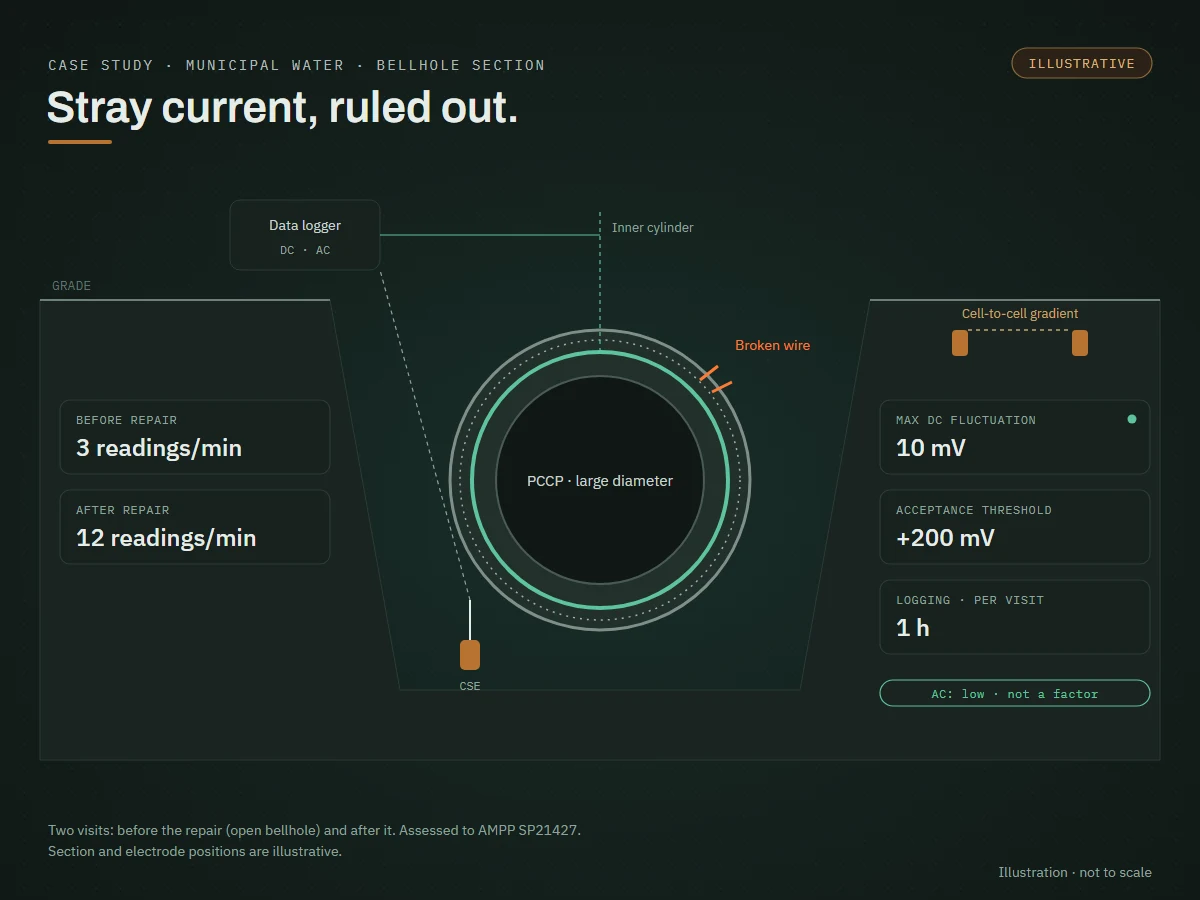
What we did
- 01Measure the failed jointWith the bellhole open before the repair, the potentials of the joint's steel components (broken wire, continuous wire and inner cylinder) were measured against a copper-copper sulfate reference electrode.
- 02Log for fluctuationsReinforcing wire and inner cylinder potentials, DC and AC, were logged for one hour at 3 readings per minute to catch fluctuations from foreign stray current sources.
- 03Read the soil gradientsSoil cell-to-cell voltage gradients were logged east-west and north-south outside the bellhole, and soil resistivity was measured.
- 04Come back after the repairA second visit after the repair ran a full hour of cell-to-cell gradient logging at 12 readings per minute.
- 05Assess against the standardResults were assessed against AMPP SP21427 for DC stray current and the general 30 A/m² AC current density criterion for buried steel.
Have a similar asset?
Tell us about the main, line or structure. An engineer reads every request, and anything that needs a stamp goes to one of our Professional Engineers.