

CASE STUDY 06 · ALBERTA · GAS DISTRIBUTION
AC interference study for a gas line beside two powerlines
Soil testing and a 3D electromagnetic model of an NPS 6 gas pipeline running parallel to a 138 kV and a 69 kV transmission line, to find out what the induced AC means for people at the risers and for the pipe itself.
Natural gas distribution utility
- AC interference and mitigation
- Modelling
- Soil resistivity
The problem
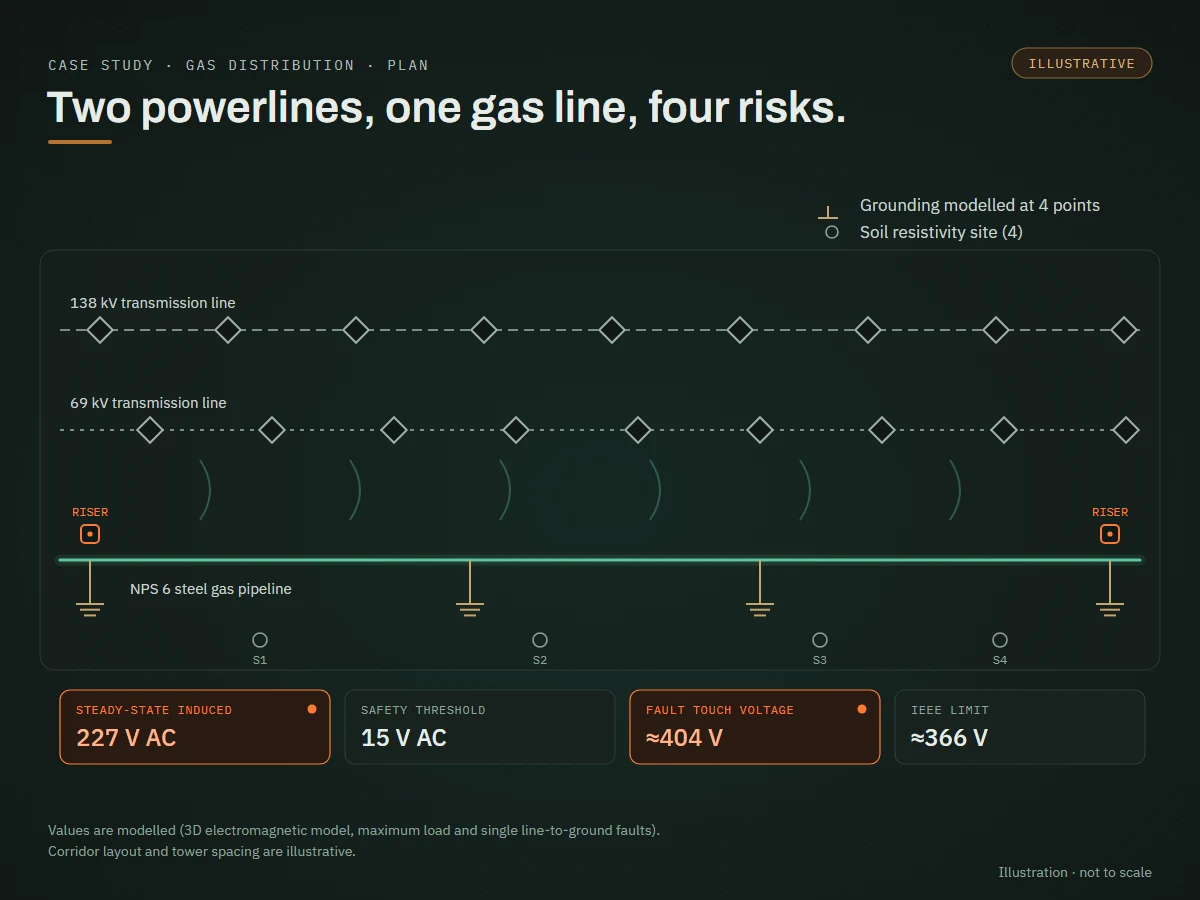
An NPS 6 steel gas pipeline runs in long parallel with two overhead transmission lines, at 138 kV and 69 kV. The owner needed to know whether induced AC creates a shock hazard at above-grade appurtenances, or an AC corrosion risk at coating holidays, under both normal load and fault conditions.
What we did
- 01Collect the right dataA structured information request gathered the pipeline details from the owner, and conductor geometry and fault levels from the transmission owner.
- 02Test the soilWenner and Schlumberger four-pin soil resistivity tests at four sites, with matrix inversion to find the soil layering.
- 03Model the corridorA 3D electromagnetic model (CDEGS) of the pipeline and both powerlines, run at maximum steady-state load and with single line-to-ground faults applied along the line.
- 04Assess all four risksSteady-state touch voltage (AMPP 15 V threshold), AC corrosion current density (NACE SP21424), fault touch voltage (IEEE Std 80) and coating stress and soil arcing (CSA C22.3 No. 6).
- 05Model the fixPreliminary mitigation modelling with grounding at both pipeline ends and two central locations, then a stamped, issued-for-design report.
Have a similar asset?
Tell us about the main, line or structure. An engineer reads every request, and anything that needs a stamp goes to one of our Professional Engineers.