

CASE STUDY 10 · ALBERTA · MUNICIPAL WATER
Why a reclaimed-water fitting failed, and what the standard should say
A root-cause review of a corrosion failure on a 15.3 km reclaimed-water line, and the changes to the owner's standards and CP specification that stop the next one.
Municipal water utility · via its engineering consultant
- Cathodic Protection
- Failure analysis
- Specification review
The problem
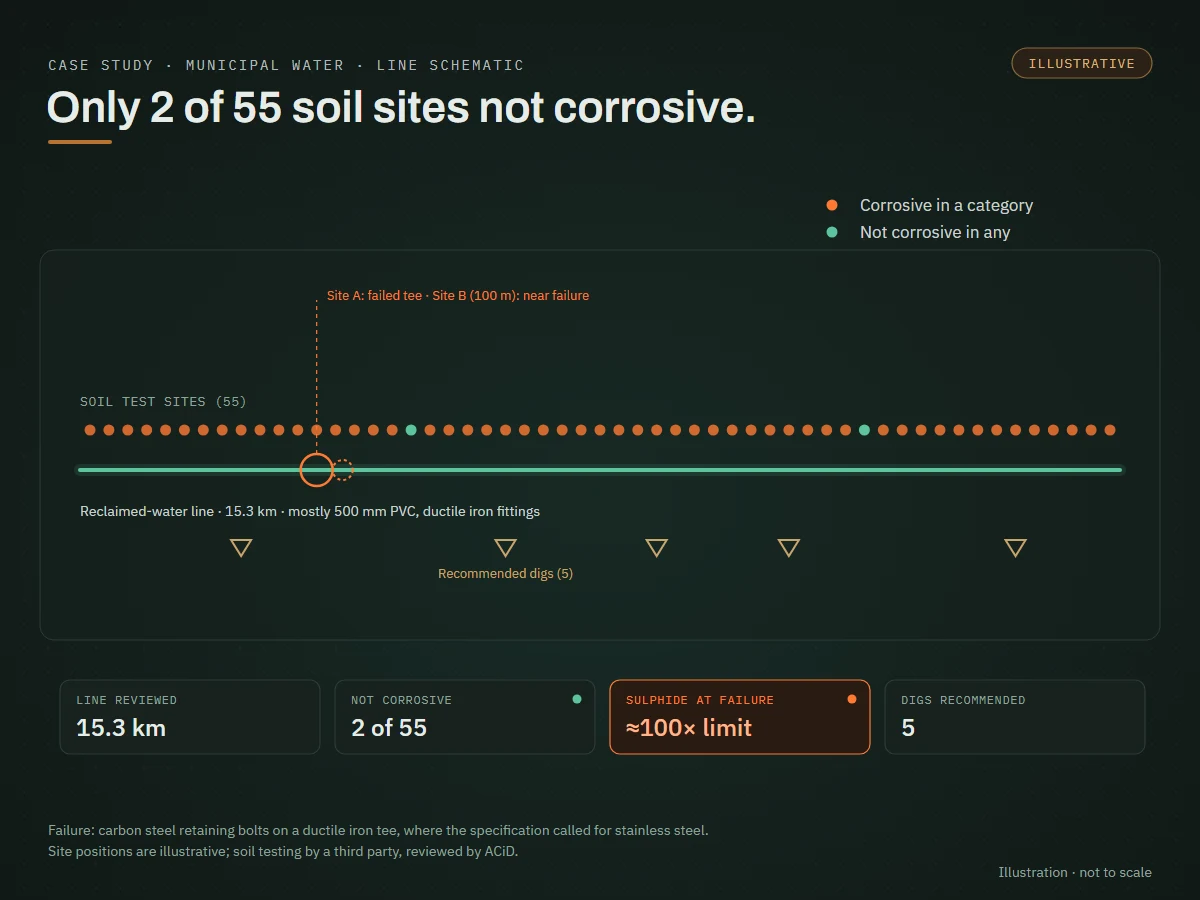
On a reclaimed-water line of mostly 500 mm PVC pipe with ductile iron valves and fittings, the carbon steel retaining bolts on a ductile iron tee corroded through. A test dig 100 m away found another fitting close to failure. The owner needed the root cause, and changes to its standards to prevent more failures on this line and on similar systems.
What we did
- 01Gather the evidenceAs-built drawings, post-failure photos, a third-party metallurgical analysis of the second fitting and third-party soil data from 55 test holes along the right of way were reviewed.
- 02Benchmark the criteriaThe owner's soil-corrosivity limits were compared with ASTM, AWWA, DIN EN 12501 and Caltrans limits, and the new soil results with the pre-construction testing.
- 03Check what was builtMaterials, coatings and CP were checked against the specifications. The bolts were carbon steel where the specification called for stainless steel.
- 04Look for MICMicrobiologically influenced corrosion indicators and the effect of polyethylene encasement on CP were assessed, with sample zinc versus magnesium anode calculations.
- 05Fix the standard, plan the lineRecommendations for the owner's standards (CP by or under an AMPP CP2 technician, magnesium anodes and surveyable CP where soils exceed the limits, no polyethylene encasement with CP) and for the line itself, including a dig programme.
Have a similar asset?
Tell us about the main, line or structure. An engineer reads every request, and anything that needs a stamp goes to one of our Professional Engineers.