

CASE STUDY 12 · THE PRAIRIES · SOLUTION MINING
Computational modelling cut a well pad's CP requirement by a third
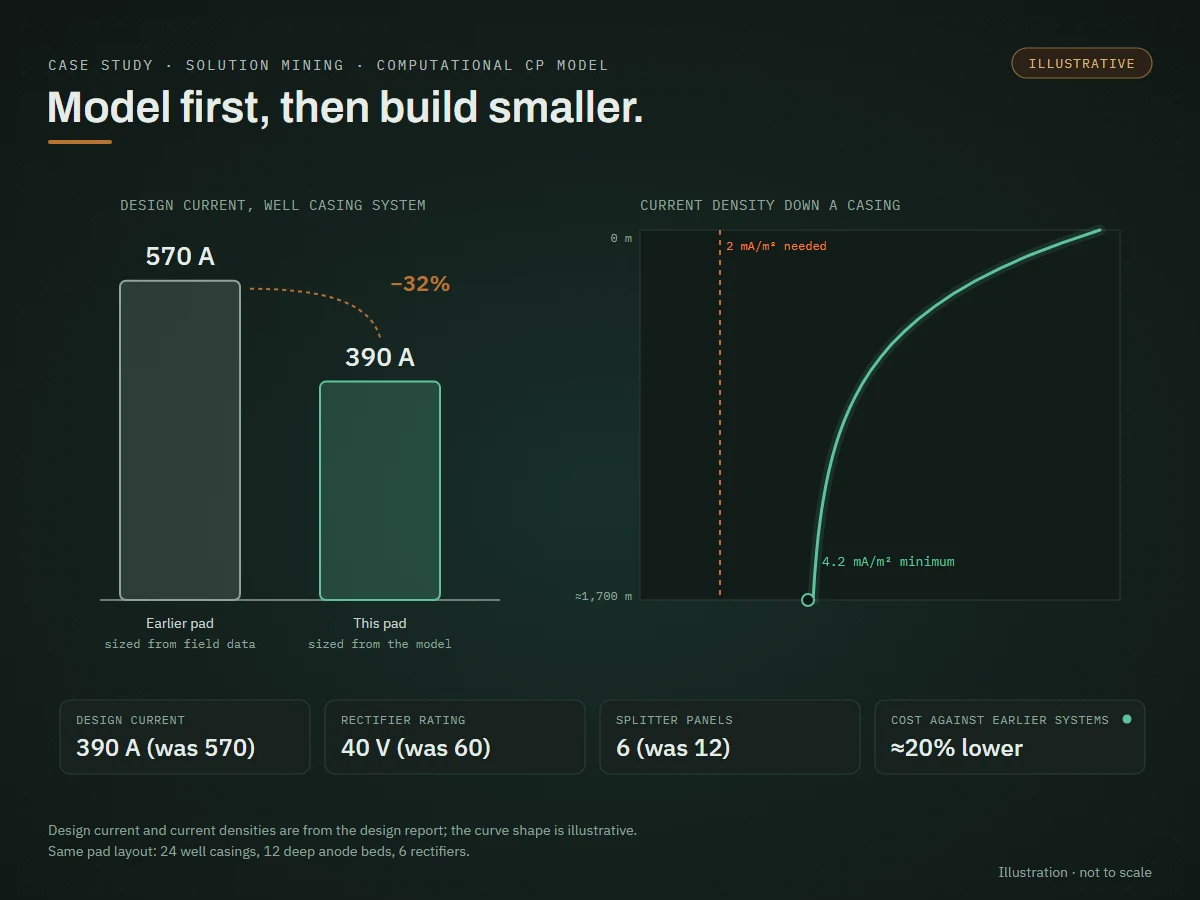
On the next well pad at the same facility, we modelled current down every casing before sizing anything. The design came out at 390 A instead of 570 A, with smaller rectifiers and half the panels, and about 20% lower cost than the earlier systems there.
Solution-mining operator · second well pad of injection and production wells
- Cathodic Protection
- Computational modelling
- Value engineering
The problem
The operator was adding another pad of 24 hot injection and production well casings, each about 1,700 m long. Earlier systems at the facility had been sized from theory and field data from older pads, and annual surveys were showing interference and overprotection. The question was how little current would still protect the full depth of every casing.
What we did
- 01Model the current, not just the groundEach casing was modelled from its surface location to its downhole location (at least 300 m apart), with the twelve deep anode beds placed as they would be built. The hard part is getting current to the bottom of the casings.
- 02Size to the resultThe model showed a minimum current density of about 4.2 mA/m² on the production casings, against the 2 mA/m² assumed necessary for deep steel. That supported 390 A in total instead of the 570 A used on the earlier pad.
- 03Simplify what the smaller current allowsRectifiers dropped from 60 V to 40 V, with about 31% less AC power each, and the splitter panels were halved. Buried reference electrodes and test stations on the trench piping were left out.
Have a similar asset?
Tell us about the wells, pad or line. An Integrity professional reads every request, and anything that needs a stamp goes to one of our Professional Engineers.